
💬 Quotes & Concepts
- “You suck until further notice. At this stage you can bite all you want with no remorse. All your elders will say is, “Awww isn’t that cute, kootchie kootchie koo.” So steal that dope connection, rob that color scheme, and loot whole letterforms. Dont worry about giving any credit, we’ll pat ourselves on the back and brag how we’re influencing the next generation.”
- “Jealousy is a disease for the weak. Pretty soon somebody will steal your secret sauce and the cycle will be renewed. If this happens to you, don’t b_tch about not getting your due. Graffiti is the language of the ignored. If your style is stolen, someone heard you speaking. You got what you wanted from the beginning, some attention, you big baby.”
- “Your heart is your greatest possession, dont let it get taken from you. There’s nothing wrong with knowing your the sh_t as long as you are. But once you reach that conclusion, your one foot over the edge of falling off. Watch your step fathead, there’s no shortage of people chanting, “JUMP JUMP JUMP!” There are plenty of writers that have been painting well for the better part of 20 years, and your posing and fronting looks r_tarded next to them. Get back to work, you “never was” slouch.”
- “Graffiti is free, impresses the girls, is heroic in our couch potato culture, will provide you with a million stories to tell at parties, and a sure cure for the inner-city blues. If it’s not fun, you’re doing it wrong or have been doing it too long.”
- “Give soul claps, firm handshakes, and throw smooth bolo punches.”
🎨 In love with Bill Braun’s paintings. Yes, you read that correctly— paintings:
I don’t like to give an artist statement because it undoes the premise of my work, trompe l’oeil painting. Literally from the French, trompe l’oeil means “trick the eye”. An artist’s statement might undo the fundamental aim of convincing the viewer, at least for a moment, that what he sees are actual objects and not a painting.
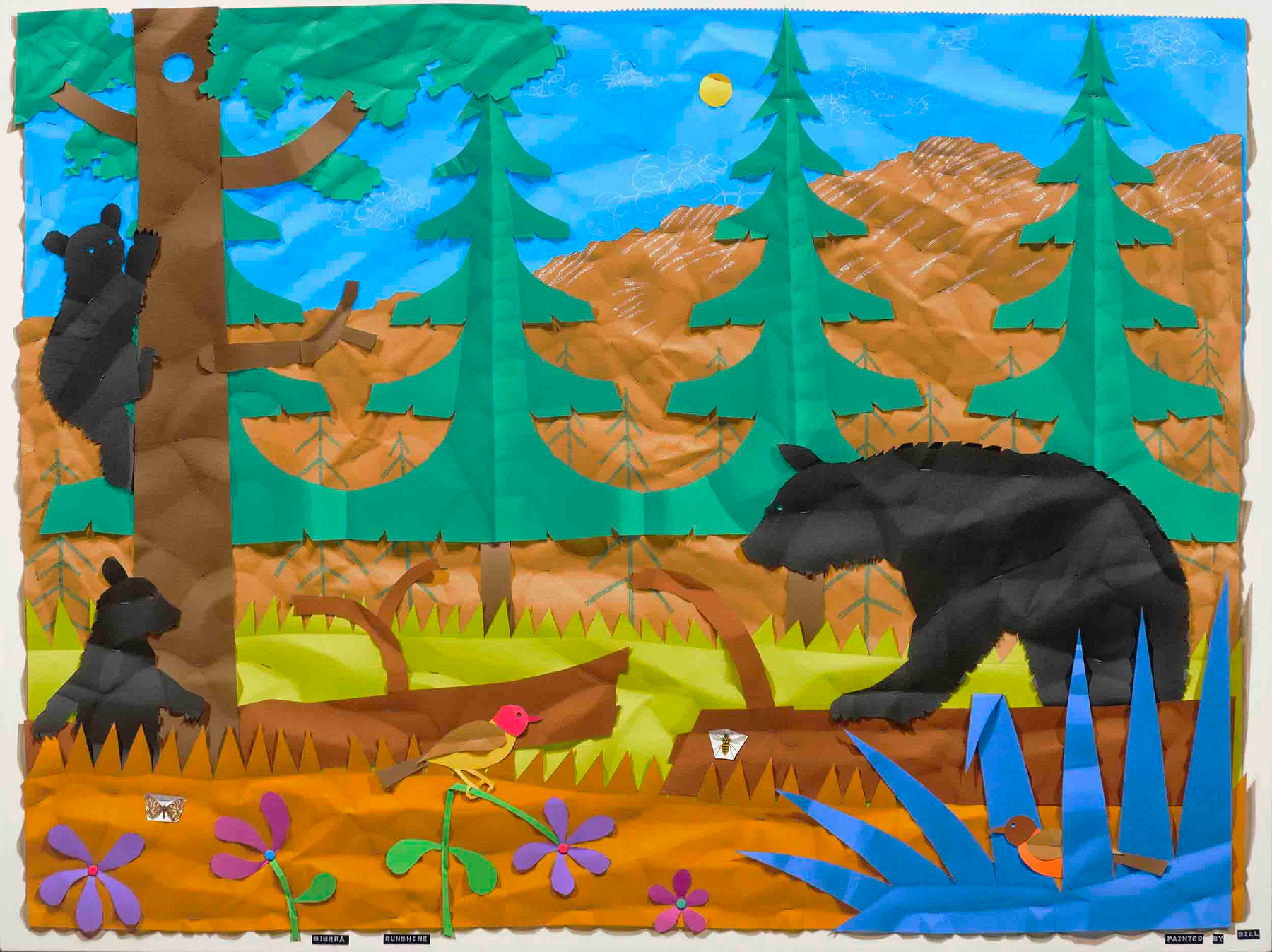
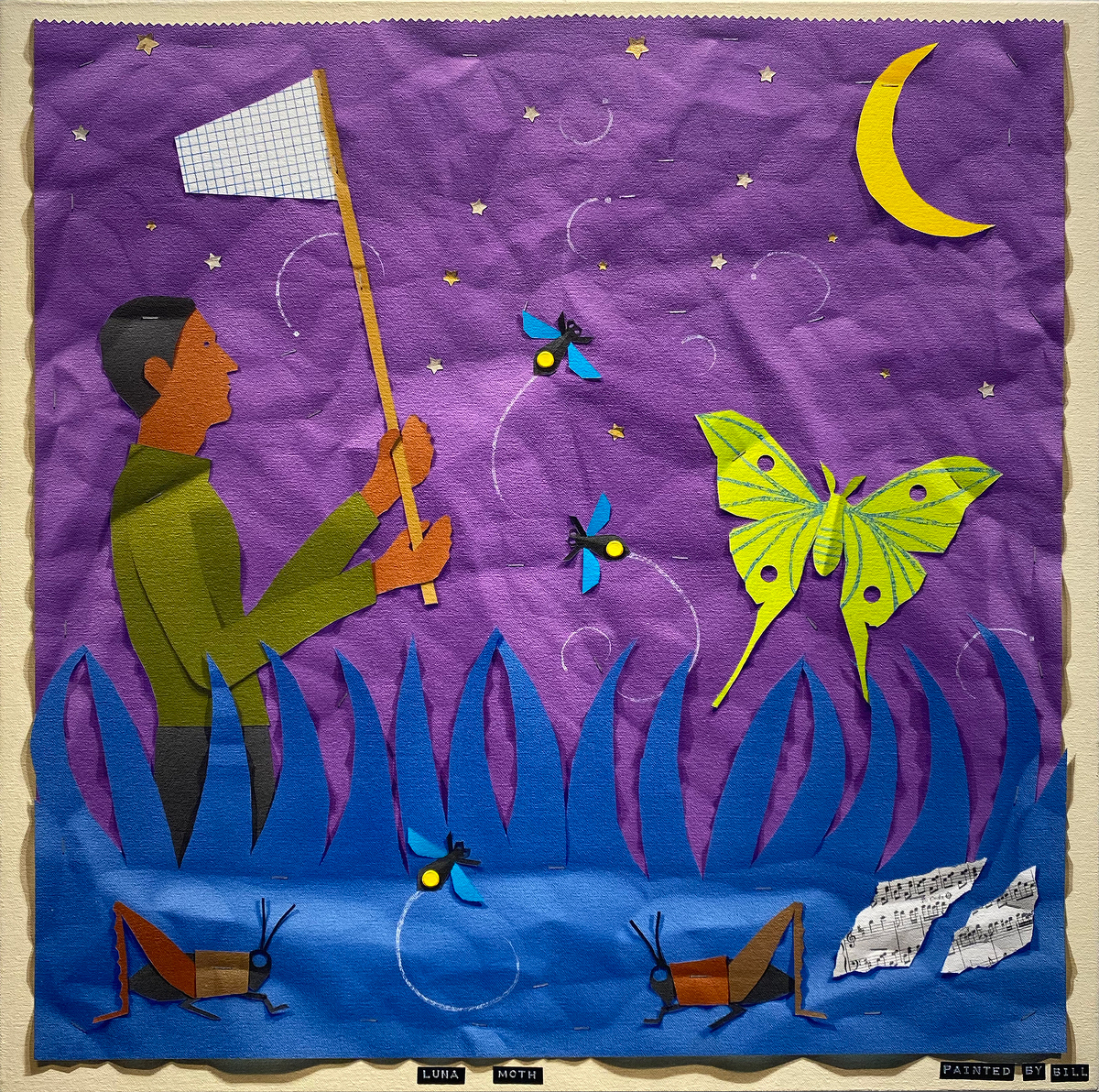
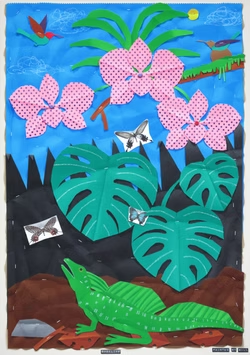
🎨 In love with Bill Braun’s paintings. Yes, you read that correctly— paintings:
“I don’t like to give an artist statement because it undoes the premise of my work, trompe l’oeil painting. Literally from the French, trompe l’oeil means “trick the eye”. An artist’s statement might undo the fundamental aim of convincing the viewer, at least for a moment, that what he sees are actual objects and not a painting.” — Bill Braun
💬 Raoul Vaneigem’s opening line in The Revolution of Everyday Life:
“I LIVE ON THE EDGE OF THE UNIVERSE AND I DON’T NEED TO FEEL SECURE.”
💬 U.S. Supreme Court Justice John Marshall Harlan II in Cohen v. California (1971):
“One man’s vulgarity is another’s lyric."
💬 Bilbo’s birthday speech that was given after the final meal at Bilbo Baggins' 111st birthday party on the 22nd of September:
My dear People, My dear Bagginses and Boffins, and my dear Tooks and Brandybucks, and Grubbs, and Chubbs, and Burrowses, and Hornblowers, and Bolgers, Bracegirdles, Goodbodies, Brockhouses and Proudfoots. Also my good Sackville-Bagginses that I welcome back at last to Bag End. Today is my one hundred and eleventh birthday: I am eleventy-one today! I hope you are all enjoying yourselves as much as I am. I shall not keep you long. I have called you all together for a Purpose. Indeed, for Three Purposes!
First of all, to tell you that I am immensely fond of you all, and that eleventy-one years is too short a time to live among such excellent and admirable hobbits.
I don’t know half of you half as well as I should like; and I like less than half of you half as well as you deserve.
Secondly, to celebrate my birthday. I should say: OUR birthday. For it is, of course, also the birthday of my heir and nephew, Frodo. He comes of age and into his inheritance today. Together we score one hundred and forty-four. Your numbers were chosen to fit this remarkable total: One Gross, if I may use the expression.
It is also, if I may be allowed to refer to ancient history, the anniversary of my arrival by barrel at Esgaroth on the Long Lake; though the fact that it was my birthday slipped my memory on that occasion. I was only fifty-one then, and birthdays did not seem so important. The banquet was very splendid, however, though I had a bad cold at the time, I remember, and could only say ‘thag you very buch’. I now repeat it more correctly: Thank you very much for coming to my little party.
I wish to make an ANNOUNCEMENT.
I regret to announce that - though, as I said, eleventy-one years is far too short a time to spend among you - this is the END. I am going. I am leaving NOW.
GOOD-BYE!
🎉 Today would’ve been the 100th birthday of the one and only— Ivan Illich. Truly, Illich possessed an intellect, a spirit, and an integrity that the world has rarely seen. I am from a very different generation, but owe him a great debt and am grateful for the life he lived.
“Man must choose whether he wants to be rich in things or in the freedom to use them.”
💬 In love with this poem that I have only just come across for the first time. From the late Wendell Berry:
A Warning to my Readers
Do not think me gentle
because I speak in praise
of gentleness, or elegant
because I honor the grace
that keeps this world. I am
a man crude as any,
gross of speech, intolerant,
stubborn, angry, full
of fists and furies. That I
may have spoken well
at times, is not natural.
A wonder is what it is.
Reading this, I feel so seen. Rest In Peace, Wendell.
🕊️ Rest In Peace, Wendell Berry.
When despair for the world grows in me
and I wake in the night at the least sound
in fear of what my life and my children’s lives may be,
I go and lie down where the wood drake
rests in his beauty on the water, and the great heron feeds.
I come into the peace of wild things
who do not tax their lives with forethought
of grief. I come into the presence of still water.
And I feel above me the day-blind stars
waiting with their light. For a time
I rest in the grace of the world, and am free.
💬 The IndieWeb is Punk Manifesto I now swear by:
THE INDIEWEB IS PUNK MANIFESTO
Three chords and a domain name.
You don’t need a deal with a label. You don’t need a platform’s blessing. All you need is an out of tune guitar you can barely play, or a free text editor and a web host. That’s it. That’s the whole scene.
I. WE ARE THE DIY KIDS
Punk didn’t wait for labels to say yes. It plugged in a blown out amp in someone’s basement and played anyway. Bad singer? Makes no difference. Three chords? You go. Own a drum kit but never had a lesson? You’re the drummer now.
The IndieWeb works the same way. Nobody’s waiting for permission to publish a website. You don’t need a “content strategy.” You don’t need a niche. You need a place that’s yours, and the nerve to hit publish.
Sometimes it’s ugly. It’s the wrong font. It’s a blog post about nothing at all. It works and it’s yours.
II. WE OWN THE MASTERS NOW
In the old days, the music industry owned the masters, the distribution, the airwaves. You made the music; they made the money and decided if anyone got to hear it.
Big platforms run the same racket. You write the posts, build the audience, generate the engagement, and they own the feed, the algorithm, and the right to bury you or boot you whenever it suits the shareholders.
Not here. Own your domain. Own your data. Own your identity. Your words live on infrastructure you control, not on borrowed servers that can evict you without notice.
III. NO A&R, NO VENTURE CAPITAL, NO GATEKEEPERS
No punk band was chasing a platinum record. Punk was about making music and getting it into people’s hands - that was the whole transaction.
No indie web builder is chasing Series A. We’re not optimizing for growth. We’re not selling your attention to advertisers. We charge a fair price for a real thing, if we even charge at all, and either way nobody’s pitching us to a boardroom.
Small. Sustainable. Answerable to no one but ourselves.
IV. THE ZINE NEVER DIED, IT JUST GOT A DOMAIN
Punk had zines - cut, pasted, photocopied, and passed hand to hand because the real press wouldn’t cover it. That’s blogging before anyone even called it blogging.
We still do that. A blog is a zine with better uptime. An RSS feed is a mailing list that never asks for your email. Webmentions are show flyers stapled to telephone poles all over town, pointing back to each other, building the scene a link at a time.
Community over audience. Nobody in this room is just watching.
V. MAKE WHAT YOU NEED, NOT WHAT “EVERYONE” NEEDS
Stop designing for some hypothetical user that doesn’t exist. Build the thing that scratches your itch. Use it yourself - eat your own dog food. If you’re not depending on it, why would anyone else?
Do this enough, in the open, sharing your code and your notes and your half-finished ideas posted for all to see, and the rest of the scene will pick it up. That’s how it spreads: not top-down, but kid to kid, site to site.
VI. WEIRD IS A FEATURE
GeoCities had hideous backgrounds, animated GIFs, and a MIDI file that played on page load. It was ugly, but it was also alive in a way no template can ever be.
We’re not going for pixel-perfect. We’re not A/B testing a homepage. Have fun, or what’s the point? Keep the web weird. Keep it handmade. Keep the mohawks.
VII. IT’S AN ALL-AGES SHOW
Punk wasn’t always right about this. Each scene had its bouncers at the door and idiots in the pit. Bands worth remembering spent half their set shouting them back out - Rock Against Racism, Riot Grrrl, the Dead Kennedys writing a song to tell the Nazi punks exactly where to go. That wasn’t a side project. It was a full-time job.
So… Everybody gets a seat on the Indieweb. No matter your color, faith, gender, who you love, how your brain is wired, what your body can do, how old you are, where you were born, or which language you write in. Nobody at this door is taking a ticket.
No degree, no job title, no follower count, no years of experience, no permission from others who were on the scene first.
And if you’re already inside, hold the door open for others. Link to the new kids. Answer beginner questions without snark. Write the alt text, caption the video, keep it keyboard-reachable. A site nobody can use is a club with stairs at the doors and no accessibility ramp.
All are welcome on the Indieweb. It’s not a code of conduct bolted on after the fact. It’s the entire reason we’ve built our own places on the Web to begin with.
VIII. THIS IS THE COUNTERCULTURE NOW
In the ’80s and ’90s, blasting Punk Rock was a way of telling the establishment where to stick it. Today, publishing on your own site instead of feeding the algorithm is the same middle finger, just a little quieter.
We opt out of the surveillance feed. We opt out of the engagement farm. We opt into a web made of small, stubborn, independent spaces that are loosely joined, built to last, and owned by those who make them.
We don’t need major platforms.
We have the Web, keyboards, tools, and community.
IndieWeb is Punk. Oi!
Thanks to @ayjay for putting me on.
💬 Neil Postman in Five Things We Need to Know About Technological Change:
The consequences of technological change are always vast, often unpredictable and largely irreversible. That is also why we must be suspicious of capitalists. Capitalists are by definition not only personal risk takers but, more to the point, cultural risk takers. The most creative and daring of them hope to exploit new technologies to the fullest, and do not much care what traditions are overthrown in the process or whether or not a culture is prepared to function without such traditions. Capitalists are, in a word, radicals. In America, our most significant radicals have always been capitalists—men like Bell, Edison, Ford, Carnegie, Sarnoff, Goldwyn. These men obliterated the 19th century, and created the 20th, which is why it is a mystery to me that capitalists are thought to be conservative. Perhaps it is because they are inclined to wear dark suits and grey ties. I trust you understand that in saying all this, I am making no argument for socialism. I say only that capitalists need to be carefully watched and disciplined. To be sure, they talk of family, marriage, piety, and honor but if allowed to exploit new technology to its fullest economic potential, they may undo the institutions that make such ideas possible.
💬 RE: My last post. This is the quote, among many others, that immediately confirmed I needed to purchase the book:
It is creative apperception more than anything else that makes the individual feel that life is worth living. Contrasted with this is a relationship to external reality which is one of compliance, the world and its details being recognized by only as something to be fitted in with or demanding adaptation. Compliance carries with it a sense of futility for the individual and is associated with the idea that nothing matters and that life is not worth living. In a tantalizing way many individuals have experienced just enough of creative living to recognize that for most of their time they are living uncreatively, as if caught up in the creativity of someone else, or of a machine.
This second way of living in the world is recognized as illness in psychiatric terms. In some way or other our theory includes a belief that living creatively is a healthy state, and that compliance is a sick basis for life.
Seth Godin with a great, digestible critique of Amazon:
If you’re searching for an air fryer, Amazon already knows quite a bit. They know the best-reviewed, least-returned, best-priced model. The only purpose of the ads is to get you to pick an air fryer that isn’t that one. The ads make the search worse… When there are plenty of ads, the maker of the best air fryer now has to bid on ads as well, if only to protect the sales they were entitled to in the first place. Businesses continue to buy the ads—not because they’re dumb, but because the system has created a situation with few options.
💬 Frank Sinatra giving George Michael a dose of reality:
“I don’t understand a guy who lives “in hopes of reducing the strain of his celebrity status.” Here’s a kid who “wanted to be a pop star since I was about 7 years old.” And now that he’s a smash performer and songwriter at 27 he wants to quit doing what tons of gifted youngsters all over the world would shoot grandma for - just one crack at what he’s complaining about. Come on, George. Loosen up.”
As seen in a bar in Brooklyn.

💬 Edna St. Vincent Millay:
Childhood is the kingdom where nobody dies.
From her ostensibly famous poem of the same title. I had somehow never heard it before. Beautiful and sorrowful piece on grief.
💬 Some fantastic bits for creativity in Stephen ESPO’s Rules For Graffiti:
🤖 Can you tell human writing from AI? by Dr Maria Panagiotidi:
These findings paint a slightly uncomfortable picture. We are not as good at detecting AI-generated writing as our confidence suggests. Our instincts about which features to trust are often unreliable, and the discomfort we feel about AI-generated creative work exists somewhat independently of whether we can actually identify it… If accurate identification matters for your use case, training people on what current AI systems actually tend to produce will do more than trusting general literacy or subject-matter expertise.
A Stranger Taught Me That The Keyboard Has a Favorite Hand
⌨️ Last weekend, in a bar on New York City’s Lower East Side, I was talking to some strangers when one of them revealed the most peculiar but intriguing quirk. I asked them what their favorite word is, to which one of them replied, stewardesses.
“Because I am left-handed, and it is the longest word on a traditional keyboard that can be typed using only the left hand."
Organizing words into left hand/right hand divisibility was a passion of his, he explained. Not quite a compulsion, but definitely outside the so-called “normal” range of interest. Everyone in his family had a different version of their own quirk. His father, for instance, would automatically convert letters on license plates into numbers and divide the entire string of numbers by 3 or 9.
Enthralled, I tested more of my new acquaintance’s knowledge. He explained that there are more left-hand only words than right-hand only words because the left hand position contain A and E. He told me that the longest non-scientific word on the right hand is lollipop. He knew the longest sentence that could be strung together using only the left or right, but it was so nonsensical I can’t recall what it was.
He then asked me what my favorite word is. I told him it was glizzy (because it’s impossible for me to say without laughing), and he immediately told me that it’s a balanced word with an equal distribution of right-hand and left-hand letters, although it’s imperfect because the hands don’t alternate, unlike skepticisms, which is the longest word that can be typed in perfect alternation.
Naturally, I tested my new rain man with a few more words, and sure enough, his ability to divide or count them was practically instantaneous. My mind was blown from the interaction and I have thought about it everyday since.
I am now thoroughly convinced that there should be words for left-hand and right-hand typable words, as well as for the words that are equally typed by right and left. I wonder what implications the design of the keyboard has had regarding the language used on the internet— I mean, is the keyboard one of the only products that actually favors lefties? And more importantly… why is there not a space on the web to catalog these words, track them, and explore this hobby? It feels exactly like the type of niche that should exist somewhere online. If you’re aware of it, please let me know. If not, I may need to take action…
💬
Turn and face the strange. — David Bowie
💬 From my current read, Pere Goriot:
“My life, my own life, is all in my daughters. I don’t feel cold if they are warm. I never feel sad if they are laughing. My only sorrows are theirs. When you become a father and say to yourself, as you hear your children babbling: “Thats my doing!”, when you feel these little creatures attached to you by every drop of your blood (for they were its finest flower, and thats the truth!) you will think that their skin is an inseparable part of you, your body will seem to respond to their movements. There voice speaks to me wherever I am.”
Beautiful so far.
💬 It’s been years, yet Haley Nahman is still one of my favorite writers. Certainly the best on Substack. Love seeing her do a simple observational blog post.