💬 Quotes
💬 Marshall Mcluhan on his pioneering work in media ecology:
“It is now perfectly plain to me that all media are environments, all media have the effects that geographers and biologists have in the past associated with environments. The medium is the message because the environment transforms our perceptions governing the areas of attention and neglect alike… All of my recommendations, therefore, can be reduced to this one: study the modes of the media, in order to hoick all assumptions out of the subliminal, non-verbal realms for scrutiny and for prediction and control of human purpose."
💬 A classic zinger from the incomparable Peter Drucker:
“The greatest danger in times of turbulence is not the turbulence. It is to act with yesterday’s logic.”
💬 Thinking a lot on Phillip Larkin’s poem Aubade lately and taking comfort from it. May write on it soon. Here is one glorious snippet:
And so it stays just on the edge of vision,
A small unfocused blur, a standing chill
That slows each impulse down to indecision.
Most things may never happen: this one will,
And realisation of it rages out In furnace-fear when we are caught without
People or drink. Courage is no good: It means not scaring others. Being brave
Lets no one off the grave. Death is no different whined at than withstood.
💬 From Ralph Waldo Emerson:
“People do not seem to realize that their opinion of the world is also a confession of their character.”
💬 From Orwell, in As I Please:
But the claim that ‘there is nothing new under the sun’ is one of the stock arguments of intelligent reactionaries… It is not very difficult to see that this idea is rooted in the fear of progress. If there is nothing new under the sun, if the past in some shape or another always returns, then the future when it comes will be something familiar. At any rate what will never come — since it has never come before — is that hated, dreaded thing, a world of free and equal human beings… Particularly comforting to reactionary thinkers is the idea of a cyclical universe, in which the same chain of events happens over and over again. In such a universe every seeming advance towards democracy simply means that the coming age of tyranny and privilege is a little bit nearer. This belief, obviously superstitious though it is, is widely held nowadays, and is common among Fascists and near-Fascists.
💬 A reminder from Friedrich Hölderlin:
But where the danger is, also grows the saving power
💬 From Anais Nin:
“Life shrinks or expands in proportion to one’s courage.”
💬 From Down and Out in Paris and London:
I believe that this instinct to perpetuate useless work is, at bottom, simply fear of the mob. The mob are such low animals that they would be dangerous if they had leisure; it is safer to keep them too busy to think. [This fear] is a superstitious fear. It is based on the idea that there is some mysterious, fundamental difference between rich and poor, as though they were two different races, like negroes and white men. But in reality there is no such difference. The mass of the rich and poor are differentiated by their income and nothing else, and the average millionaire is only the average dishwasher dressed in a new suit. Everyone who has mixed on equal terms with the poor know this quite well.
🗞️ From Dispatch #002 of Mercury’s Playbook:
Indeed—of all the marketplaces and industries in the world, luxury is perhaps the most intriguing when it comes to consumer psychology, simply because it proves that utility and functionality are not the end-all-be-all of product appeal. It provides a rich study into one of humanity’s most fundamental desires—the need to feel special, superior, and set apart. When it comes to crafting desirable products, no one does it better than the luxury industry because luxury is product charged with meaning to the utmost degree.
💬 Brooklyn-based band Geese talking about their creative process. I relate heavily:
“Well, it kind of starts with someone else’s pre-existing song most of the time, honestly. We’re pretty referential in what we do. Even if we try not to be, we can’t help it. So we find something we want to filter through ourselves, and then we sort of have to work backwards to try and un-plagiarize it. And that’s the part that requires the creativity.
💬 Prof Glenn Okun in my class tonight:
”All genius is just someone else’s undisclosed process.”
💬
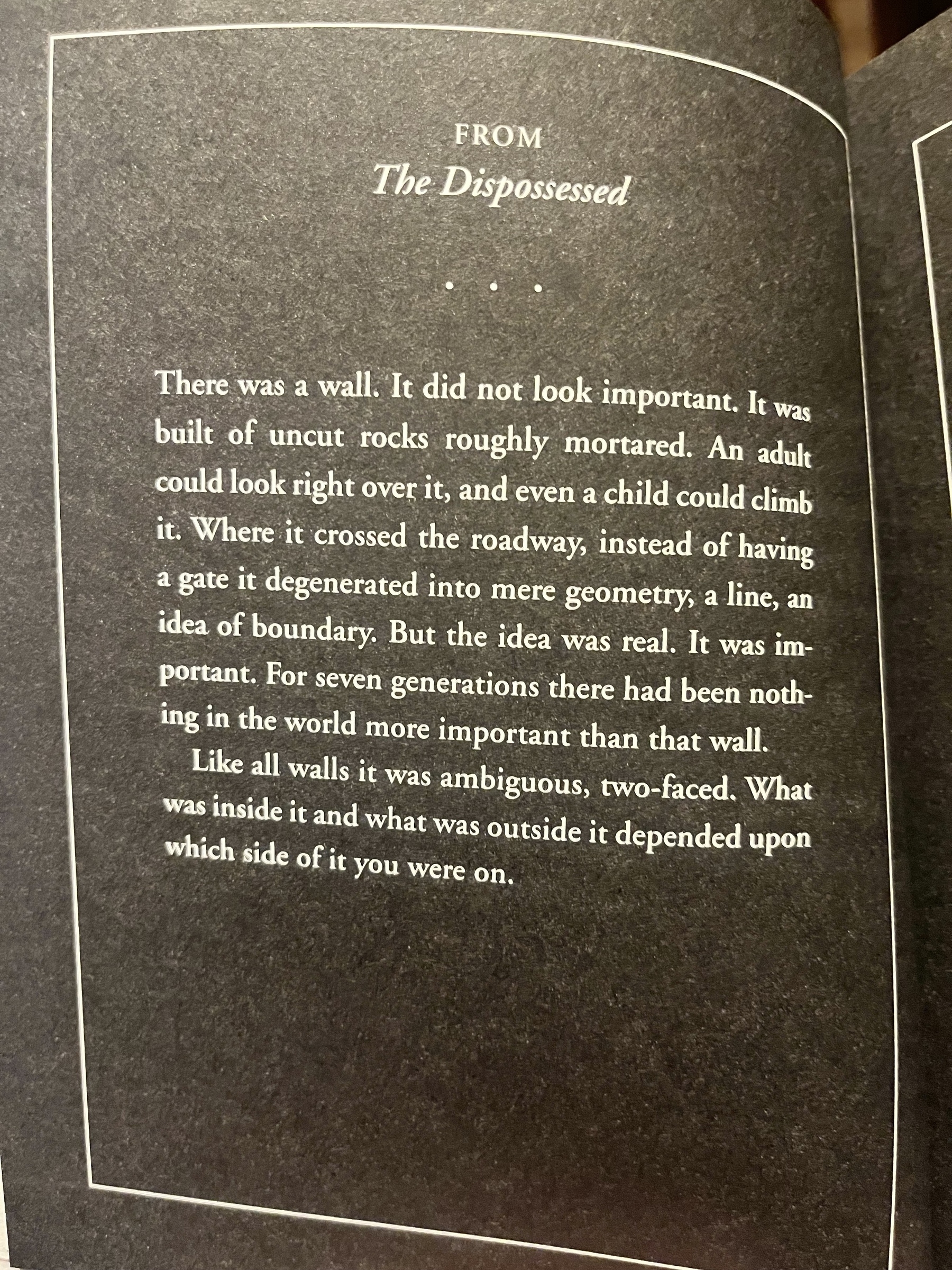
I think here of how difficult it can be to make a decision, the agony in wanting to make the right choice, knowing all the while that “right” is impossible. There’s an oft-unspoken effort to avoid regret in that agonizing. But that effort represents a kind of paradox: the anguish exists because regret is inevitable. To live is to regret. More than that, to live well is to care for your regrets, to accept their role as teacher and guide.
💬 From my current read, How Big Things Get Done:
Only 8.5% of projects hit the mark on both cost and time. And a minuscule .5% nail cost, time, and benefits. Or to put another way, 91.5% of projects go over budget, over schedule, or both. And 99.5% of projects go over budget, over schedule, under benefits, or some combination of these.
Really intrigued to see where this goes and how he fixes these problems.
💬 From Victor Papanek in Design For The Real World:
Man and his environment participate in molding each other. Man is now in the position of actually creating the total world in which he lives… In creating this world, he is actually determining what kind of an organism he will be.
💬 From Pablo Picasso (as quoted by Gertrude Stein):
“When you make a thing, a thing that is new, it is so complicated making it that it is bound to be ugly. But those who make it after you, they don’t have to worry about making it. And they can make it pretty, and so everybody can like it when the others make it after you.”
If even the rich feel burdened by the lack of an ideal, to those who suffer real deprivation an ideal is first a necessity of life. Where there is plenty of bread and a shortage of ideals, bread is no substitute for an ideal. But where bread is short, ideals are bread.
💬 Design for the Real World, Victor Papanek
💬 A thought about tricksters, creativity, and the sacred from Byrd Gibbens:
Many native traditions held clowns and tricksters as essential to any contact with the sacred. People could not pray until they had laughed, because laughter opens and frees from rigid preconception. Humans had to have tricksters within the most sacred ceremonies for fear that they forget the sacred comes through upset, reversal, surprise. The trickster in most native traditions is essential to creation, to birth.
💬 A good note on hospitality from The Odyssey:
If you are longing to go home, I would not keep you for the world, not I. I’d think myself or any other host as ill-mannered for over-friendliness as for hostility. Measure is best in everything, To send a guest packing or cling to him when he’s in haste— one sin equals the other. ‘Good entertaining ends with no detaining.’
💬 “Everything must be taken seriously, nothing tragically.”— Louis Adolphe Thiers
A solid reminder in today’s political environment.